China retains fastest supercomputer in the world crown as AI data centers soak up new hardware
China's LineShine remains the world's highest-performing supercomputer, according to the 68th edition of the Top500 list published at SC26 in Chicago on Monday. For the first time in decades, the supercomputer ranking saw exceptionally few additions despite unprecedented demand for high-performance computing hardware, as the vast amounts of compute resources deployed these days are destined for artificial intelligence (AI) data centers rather than traditional supercomputers.
Top 10 supercomputers unchanged
China's LineShine, installed at the National Supercomputer Center in Shenzhen, offers sustained FP64 compute performance of 2.198 FP64 ExaFLOPS in the High Performance Linpack (HPL) benchmark at 42.22 MW. The machine relies on the homegrown LingKun platform with 304-core Armx9-based LX2 processors clocked at 1.55 GHz (13,789,440 cores in total) and the proprietary LingQi interconnect. Unlike the other four exascale-class supercomputers, LineShine does not use any compute accelerators and exclusively relies on CPUs, which is largely why it only gains 3.6X performance when moving from FP64 to mixed-precision data, which is lower than systems that use low-precision accelerators.
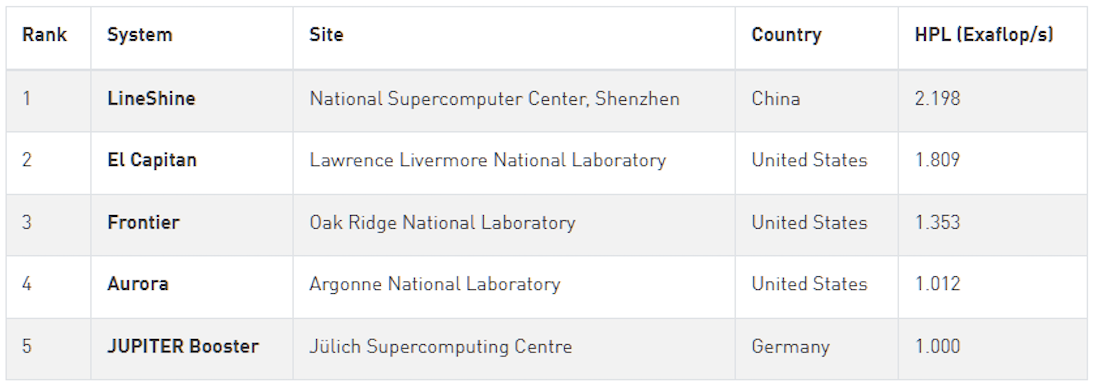
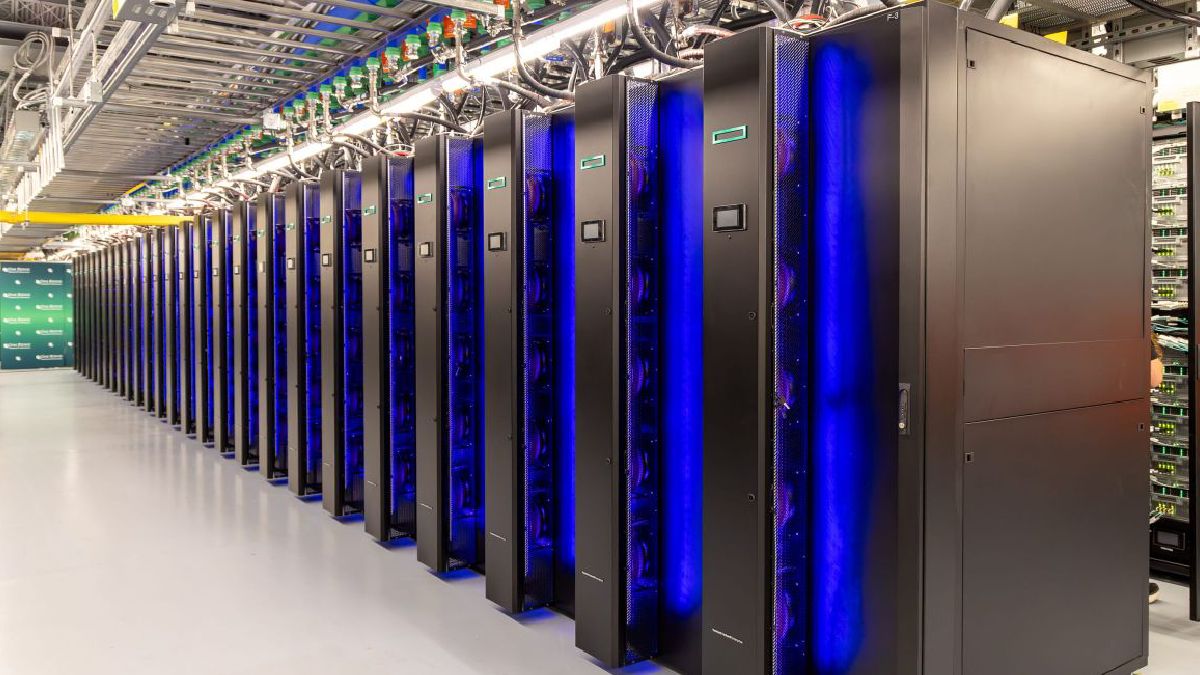
America's most powerful El Capitan supercomputer at the Lawrence Livermore National Laboratory relies on AMD's Instinct MI300A accelerated processing units (APUs), and the HPE Cray EX255a platform delivers 1.809 FP64 ExaFLOPS at 29.69 MW, which makes it significantly more power-efficient than its rival from China. The Frontier supercomputer at the Oak Ridge National Laboratory, based on AMD's 3rd Generation EPYC processors and Instinct MI250X compute GPUs, achieves 1.353 FP64 ExaFLOPS at 24.61 MW. Meanwhile, Aurora at the Argonne National Laboratory, which uses Intel's Xeon CPU Max 9470 processors and Data Center GPU Max accelerators, offers 1.012 FP64 ExaFLOPS at 38.70 MW.
All three American exascale supercomputers use HPE’s Cray EX platforms and Slingshot-11 interconnect.
Germany’s Jupiter Booster at the Jülich Supercomputing Center, which employs Nvidia’s GH200 Grace Hopper Superchips, the BullSequana XH3000 platform, and Nvidia’s quad-rail InfiniBand NDR200 interconnect, delivers 1.0 FP64 ExaFLOPS at 15.79 MW and remains the most energy-efficient exascale supercomputer on the list.
Remarkably, neither the 10 highest-performing supercomputers nor the 10 most energy-efficient machines have changed their positions since June.
Only 27 new supercomputers in Top 500
Only 27 new supercomputers (5.4% of all machines on the list) made it to the November edition of the Top 500, the lowest number since the project was founded in 1993. The most powerful newcomer is South Korea's Hanggang at the KISTI Supercomputing Center, which occupies the 12th position with 342.6 FP64 PFLOPS. The machine uses Nvidia's GH200 Grace Hopper Superchips and HPE's Cray EX254n platform. Hanggang also ranks eighth in the HPCG benchmark with 4.29 HPCG PFLOPS.
The aggregate HPL performance of the world's 500 highest-performing supercomputers increased by a modest 4.4% over the past six months to 19.57 FP64 ExaFLOPS. Nonetheless, it now takes a machine with 2.857 PFLOPS of sustained FP64 performance to qualify for the TOP500, up 7.3% from 2.662 PFLOPS in June. The performance of the systems ranked 50th and 100th rose from 49.85 PFLOPS to 55.81 PFLOPS (12%) and from 21.85 PFLOPS to 22.74 PFLOPS, respectively. Also, there are now 27 machines that deliver at least 100 PFLOPS of FP64 performance, up from 25 in June, whereas the number of supercomputers equipped with compute accelerators increased from 275 to 291 (58.2%).
Everything goes to AI data centers
The historically low number of new entrants to the Top 500 is particularly noteworthy given the unprecedented scale of investments in advanced computing infrastructure these days. According to estimates by Epoch AI cited by the Top 500 authors, the amount of AI compute capacity added globally every quarter has increased by 2.5X per year. Essentially, the industry's priorities have shifted from construction of machines capable of solving exceptionally complex scientific problems to deployment of vast amounts of compute capacity for commercial AI workloads.
In fact, the world's installed AI compute capacity already exceeds the equivalent of 15 million Nvidia H100 GPUs, according to Epoch AI. Furthermore, as of the fourth quarter of 2025, five major American hyperscalers accounted for an estimated 71% of the world's AI compute resources, much of which was deployed in massive clusters. While demand for advanced computing hardware is at an all-time high, it appears that the vast majority of new hardware never makes it to the world's most known supercomputer ranking.