AMD says it will outsell Intel for the first time in its history as Epyc and Instinct sales soar on AI demand
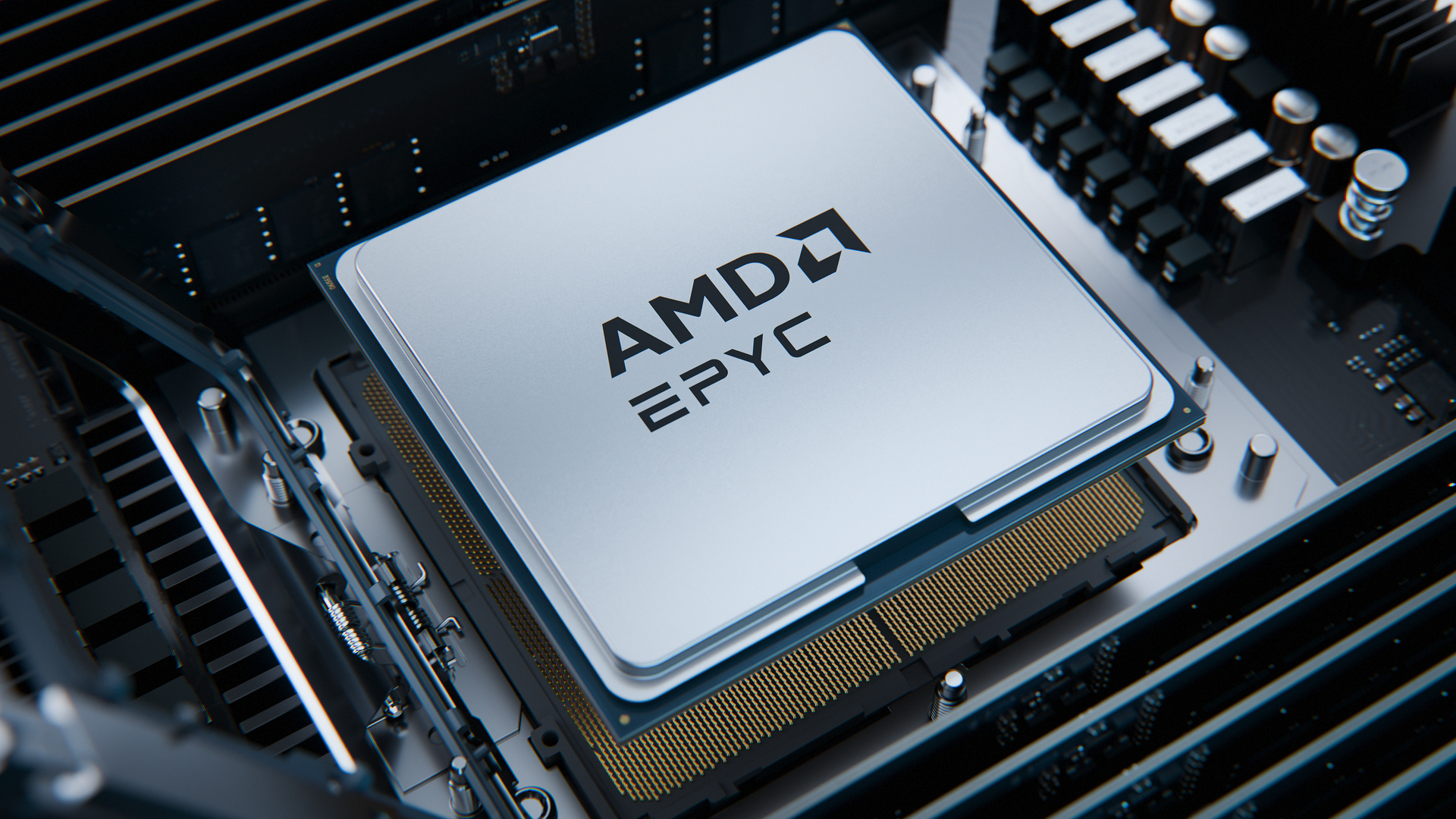
- AMD guided Q4 2026 revenue to about $17 billion, above Intel's $15 to $16 billion forecast, which would make it the larger company in terms of raw revenue for the first time
- Data center sales nearly doubled to $8.5 billion in Q3 as Instinct MI455X GPUs and Helios racks started shipping
- The lead, interestingly, is in revenue, not volume: Intel still ships about two-thirds of x86 CPUs, and AI accelerators are set to outsell Epyc inside AMD this quarter
AMD has told investors to expect fourth-quarter 2026 revenues of around $17 billion, plus or minus 3%.
If that lofty forecast holds, AMD would bring in more money than Intel in a single quarter for the first time in the two companies' decades-long rivalry.
For context, AMD's outlook arrived with a record third quarter in which revenue rose 45% year over year to $13.4 billion, even as Intel, which reported a week earlier, has guided to between $15 billion and $16 billion for the same three months.
A numbers game in revenue, not volume as data centers do the heavy lifting
Using the midpoint of both companies' estimates and assuming both predictions come true, AMD is essentially set to generate $1.5 billion more in revenue than its traditional chipmaking rival.
Much of this comes from AMD's data center gains: Data center revenue climbed 97% to a record $8.5 billion, or 64% of total sales, up from 47% a year earlier, with the segment's operating margin widening to 34%.
AMD CEO Lisa Su said Q3 was the first quarter AMD shipped Instinct MI455X accelerators and Helios racks for revenue, with Anthropic, Meta, Microsoft, OpenAI and Oracle bringing their first racks online.
Revenue shipments of 2nm Epyc "Venice" processors also began, although, as TechRadar Pro reported at launch, the full Venice stack will not ship until 2027, so there is potentially more uplift in the pipeline assuming demand remains on track.
The picture elsewhere was mixed at best: Client revenue rose 7% to $2.9 billion, gaming fell 40% to $773 million on weaker console chip sales, and embedded grew an impressive 29% to $1.1 billion.
For Q4, CFO Jean Hu guided data center revenue up about 50% sequentially, which Tom's Hardware puts at roughly $12.8 billion, with client and gaming down more than 20% and embedded up by double digits. She added that Q4 will be the first quarter in which AMD's data center AI business, meaning Instinct GPUs and racks, outsells its server CPUs, and by a wide margin.
Intel's numbers, on the other hand, are not essentially a clean baseline, even if AMD comes out ahead regardless: Its outlook accounts for lost output from the October 14 explosion at Fab 28 in Kiryat Gat, Israel, which killed two workers and shut the plant for around two weeks. "Our guidance includes an impact of roughly $300 million to revenue," CFO Dave Zinsner told analysts, according to Calcalist, almost all of it in 10nm server products. Add that back to Intel's high end, and you get $16.3 billion, still below AMD's estimated floor.
The crossover does not seem to have been on the cards so soon, however: Wall Street was looking for about $17.05 billion from Intel, according to Futurum, and around $16.2 billion from AMD, per Opening Bell Daily. As recently as April, consensus estimates had AMD surpassing Intel in revenue in 2027, and AMD's moves seem to have been considerably ahead of analyst estimates, resulting in the stock surging more than 100% YTD despite a steep AI selloff lately.
The move is a revenue milestone, not a volume one; Intel still ships most x86 processors, holding 65.9% of the market in Q2 2026, according to Mercury Research figures reported by HotHardware. AMD's revenue also includes businesses Intel does not run at comparable scale, from Xilinx-derived embedded chips and console silicon to, above all, Instinct accelerators, making for a skewed direct comparison between the two, especially as the latter is reaping AI bonuses at a scale the former cannot currently hope to match.
In fairness, AMD's data center segment has outearned Intel's equivalent group before: TechRadar Pro reported the first such quarter in Q3 2024, when AMD's $3.5 billion edged past Intel's $3.3 billion, but its recent revenue explosion has carried AMD into what seems to be an insurmountable short-term lead. In Q3 2026, it was $8.5 billion, compared with $7.3 billion for Intel's Data Center and AI group. But with GPUs set to overtake Epyc inside AMD this quarter, the overall crossover owes more to a market Intel has barely entered than to the CPU fight that defined the rivalry. Intel's own data center accelerator, the GPU D-series formerly codenamed Crescent Island, is still upcoming.
Other factors
It would also be a mistake to read Intel's forecast as an exodus of customers: Intel's Q3 revenue rose 21%, and its data center group grew 78%, and CEO Lip-Bu Tan said the immediate priority is to "unlock additional supply to meet extraordinary demand for our Xeon family."
Part of Intel's problem is capacity, layered on top of a PC slump that is hitting both firms: AMD is planning for PC unit shipments to fall by a double-digit percentage in 2027.
AMD CEO Lisa Su was candid about the fact that AMD cannot build everything it could sell. "It is true that demand is higher than supply," she told analysts.
The Q4 forecast rests on a roughly 50% sequential jump in data center sales, much of it from a rack platform that shipped for revenue for the first time last quarter.
That ramp has costs: Inventory rose about $3 billion to $11.5 billion, and free cash flow was a relatively measly $554 million. AMD's biggest AI deals also come with customer warrants, which produced a $1.1 billion non-cash charge in Q3 that the company expects to grow. Likewise, revenue is concentrated in a handful of frontier labs and hyperscalers even as circular financing concerns continue to grow.
AMD now expects data center sales to make up more than 80% of revenue in 2027 and server CPU revenue to double. Delivering that depends on partners such as HPE, which became Helios' first major OEM backer and has since said Vultr will deploy the first Helios systems it builds. It also depends on the extra capacity Su has promised for 2027, which TechRadar noted is aimed at AI rather than consumer chips.
If both companies land inside their ranges, AMD will have outearned Intel for the first time. The more telling story is where that money comes from: not a knockout in the old CPU war, but a shift in the industry's revenue toward accelerators and racks that now fill data centers.